The Types of Tennis Ball Launchers, Explained
Tennis ball launchers come in three types based on weight and portability: portable, mid-range portable, and stationary. You need a machine weighing under 30 lbs for easy transport to different courts, while heavier units provide more consistent launch mechanics. Decide your needs by weighing your mobility requirements against the desired launch speed and ball capacity of the device.
Tennis Ball Launcher Types Among the Listings We Screened
| Type | What sets it apart | Listings we screened | Price range | Median max launch speed |
|---|---|---|---|---|
| Portable/Entry Level | weight up to 30 lbs | 13 | $195 to $1179 | 75 MPH |
| Mid-Range Portable | weight 30 to 60 lbs | 10 | $699 to $2189 | 75 MPH |
| Professional/Stationary | weight 60 lbs and up | 0 | – | – |
Counted over the 49 listings this site screened; a listing that does not state the figure a type is defined by is not counted under any type.
Where these choices show up in our reviews
Prices across these 3 run from $1199 to $1199; each one has a full review here.
Consider these options if you want to explore the alternatives to a tennis ball launcher.


Portable and Entry Level Tennis Ball Launchers
Portable and entry-level tennis ball launchers are defined by a weight of up to 30 lbs and a median max launch speed of 75 MPH. These machines are designed for players who need to transport their equipment in a car or carry it across a court to different practice zones. Because they prioritize weight, these models often use smaller motors or simplified feeding mechanisms that may limit the total number of balls the unit can hold at once.
Portable tennis ball launchers offer mobility at a lower price point
The primary advantage of a portable tennis ball launcher is the ability to practice in various environments without a permanent power source or heavy footprint. If you need to move between courts frequently, these units allow for a more varied practice routine. However, the trade-off for this mobility is often a lower ball capacity or a more limited range of launch patterns compared to heavier models. These machines typically sit at the lower end of the price spectrum relative to other types.
Underpowered motors in light machines can cause overheating and shutdowns
Choosing a portable model that is too light can result in a machine that struggles to maintain consistent velocity over long periods. If the motor is underpowered for the desired ball weight, the machine may experience motor overheating, which occurs when a low-torque motor is pushed to high speeds for extended periods, causing the machine to shut down. This can end a training session prematurely and force a manual reset of the device.
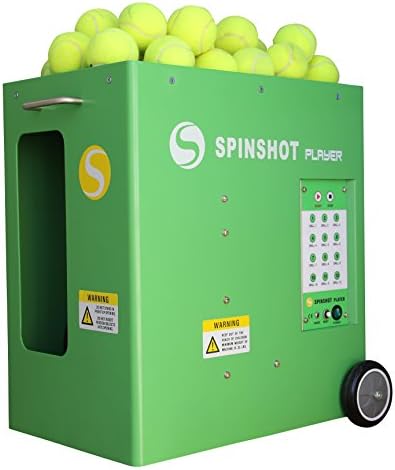
You can find a deep dive in our full review of the SPINSHOT PLAYER Plus-2.
Mid-Range Portable Tennis Ball Launchers
Mid-range portable tennis ball launchers are defined by a weight between 30 and 60 lbs and a median max launch speed of 75 MPH. These machines serve players who want a balance between mobility and high-volume output, often providing more internal storage for balls. They are suited for a coach or a dedicated player who can move a heavy piece of equipment to a specific location but does not need to carry it over long distances.
Mid-range tennis ball launchers provide stable chassis and consistent trajectories
A mid-range tennis ball launcher provides a more robust feeding system than entry-level models, which can lead to more consistent ball trajectories. By increasing the weight of the chassis, manufacturers can include larger motors and more complex internal components. This extra mass helps stabilize the machine during operation, reducing the chance of the unit shifting during a high-velocity launch. These models occupy the middle price band, offering a step up in durability and capacity from the lightest options.
Mid-range models offer higher ball capacity but require more transport effort
When you choose a mid-range option, you are often trading some ease of transport for a higher ball capacity. If you require a high volume of balls for a full hour of practice, these machines are often the preferred choice to avoid frequent reloading. However, a machine in this weight class may still be difficult for a single person to move across a large tennis court, requiring two people for transport or a cart.
For a portable option, see how the Wilson Portable Machine performs.
Professional and Stationary Tennis Ball Launchers
Professional and stationary tennis ball launchers are defined by a weight of 60 lbs and up. These machines are designed for permanent installations at tennis clubs or training academies where the machine stays in one spot for the duration of the day. Because they do not need to be portable, they can utilize larger power sources and heavy-duty components to deliver consistent, high-speed results.
Stationary tennis ball launchers provide high-volume output and constant power
The main advantage of a stationary tennis ball launcher is its ability to provide a consistent, high-volume output with a heavy-duty build. These units are often used for high-intensity drills where the machine must run for hours without a break. By removing the weight constraint, these machines can include larger batteries or direct power connections, ensuring they do not suffer from battery drain, which occurs when the power draw of the motor exceeds the capacity of a small internal battery, ending drills prematurely.
View our detailed analysis on how the PACE S performs.
Professional stationary units offer high-capacity storage and daily durability
These models represent the highest price point in the category. They give up all portability in exchange for professional-grade reliability and high-capacity storage. If you are a club owner or a full-time coach, a stationary unit provides a consistent training tool that can handle the rigors of daily use, whereas portable units might show signs of wear more quickly under such high-volume demands.
Comparison of Tennis Ball Launcher Types
| Type | Best-Fit Buyer | Main Advantage | Main Compromise |
|---|---|---|---|
| Portable/Entry Level | Individual players needing transport | High mobility | Lower ball capacity |
| Mid-Range Portable | Coaches or high-volume players | Balanced output and weight | Requires two-person transport |
| Professional/Stationary | Tennis clubs and academies | High-volume durability | Zero portability |
How to Tell Which Tennis Ball Launcher Type You Need?
You need a portable and entry-level tennis ball launcher if you frequently change practice locations and need to carry your equipment easily. If you can carry a 30 lb weight alone without fatigue, these models will meet your mobility needs. If you require a machine that can provide a high volume of balls for a continuous session, you should look toward the mid-range portable options.
Choosing between mid-range portable and stationary tennis ball launchers
You should choose a mid-range portable tennis ball launcher if you have a dedicated practice space but still need to move the machine occasionally. If you have a partner to help move the device or a cart to transport it, the increased ball capacity and stability of these models will provide a better training experience. If you are looking for a machine that stays in one spot and provides the most consistent output for hundreds of players, a professional stationary launcher is the correct choice.
Get the technical details in our full review of the Furlihong 3809BH.
Measuring transport distances helps avoid shipping costs for heavy machines
Selecting a machine that is too heavy for your transport needs can result in a return and the cost of shipping a heavy item back to the manufacturer. To avoid this, measure the distance you need to move the machine and confirm you have a way to transport the weight of the specific category you choose. For example, if you need to move a machine 100 yards across a court, a 50 lb machine will require a cart or a second person to move safely.
Differences between toss-style machines and high-velocity launch-style machines
The Slinger Bag serves as the industry benchmark for “toss-style” portable machines versus “launch-style” machines, focusing on a consistent toss rather than a high-velocity launch. In contrast, the Spinshot Player is the high-end benchmark for dual-motor spin technology and app-integrated drill programming. While the Slinger Bag focuses on portability and ease of use for a toss, the products on this page generally focus on launch-style mechanics, where the machine uses a motor to propel the ball forward at a specific velocity.
Browse our other tennis ball machine pages
- Tennis Ball Machines for Coaching Compared
- Choosing the Best Lightweight Tennis Ball Machine for Travel
- Practicing Serves Without a Hitting Partner With a Tennis Ball Launcher
- Which Tennis Ball Launcher Provides Consistent Reps for Training?
- The Tennis Ball Launchers That Train for Tennis Without a Hitting Partner
- Best Tennis Ball Machines for Beginners
Kapatan Baseball is reader-supported: some links on this page are affiliate links, and as an Amazon Associate Kapatan Baseball earns from qualifying purchases at no extra cost to you. Learn more.