Tennis Ball Launcher Explained: What It Is and How It Works
A tennis ball launcher is a motorized device that automatically feeds and propels tennis balls toward a target to simulate hitting against a person or a wall. You need a machine with a consistent launch speed to practice your stroke mechanics without needing a hitting partner or a court. Before purchasing, you should determine if you require a portable unit for travel or a stationary machine for a dedicated home training area.
Tennis ball launchers provide consistent repetition for solo practice drills
The primary problem these machines solve is the lack of consistent repetition in solo practice. Human partners often tire, and hitting against a flat wall provides a predictable rebound that does not replicate the varied angles or speeds of a real match. A tennis ball launcher automates the drill, allowing a player to focus entirely on their grip, footwork, and swing path. By removing the need to manually retrieve and reset balls, the machine increases the number of repetitions a player can complete in a single session.
If you have limited space, compare the best portable tennis ball launcher for home use to find your perfect fit.
How a Tennis Ball Launcher Functions
The operation of a tennis ball launcher follows a linear mechanical progression from the storage area to the exit point. Each step ensures the ball maintains the correct orientation for a predictable flight path.
Traveling players should evaluate the best lightweight tennis ball machine for travel for maximum mobility.
- The feed mechanism moves the ball from the hopper into the internal path.
- The internal track aligns the ball so it enters the launch zone at a consistent angle.
- The launch component applies force and rotation to the ball simultaneously.
- The ball exits the machine at a predetermined velocity and trajectory.
Tennis Ball Launchers we have reviewed in detail
Prices across these 3 run from $1199 to $1199.99; each one has a full review here.

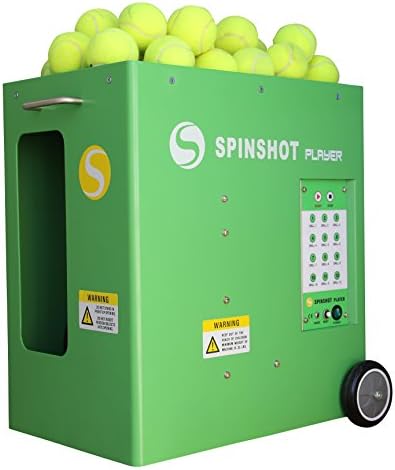

Parts and Standards of a Tennis Ball Launcher
The Feed Wheel is the mechanism that grips and pushes the ball into the launch path. If the grip on this wheel is too loose, the machine may experience ball jamming, which occurs when the feed path design cannot handle the pressure of the balls. A high-quality feed wheel ensures that the machine does not skip balls or experience a “double feed” where two balls enter the launch zone at once.
New players can find the best tennis ball machine for beginners to start their training safely.
Launch wheel diameter and texture determine ball spin and velocity
The Launch Wheel is the component that imparts spin and velocity to the ball. The diameter and surface texture of this wheel determine how much friction is applied to the ball’s surface. A larger wheel generally allows for more consistent velocity, while the texture dictates whether the ball receives topspin, backspin, or side spin. The interaction between the wheel and the ball determines the “launch feel,” which is how the ball reacts immediately after leaving the machine.
For high-intensity training, view our comparison of the best tennis ball machine for advanced drills today.
Oscillation motors move the machine to vary ball landing spots
The Oscillation Motor is the motor responsible for moving the machine side-to-side. This motor moves the entire unit across a horizontal plane to change the landing spot of the ball. Without an oscillation motor, the machine remains stationary, and the ball will land in the same spot every time unless the user physically moves the unit. This distinction determines whether the drill focuses on a single point or covers a wide area of the court.
AC and Lithium-Ion battery power options affect machine portability
Power sources are divided into AC vs. Lithium-Ion Battery options. AC power means the machine must be plugged into a wall outlet, which limits use to indoor courts or areas with easy access to power. Lithium-Ion Battery power allows for true portability, letting you move the machine to a driveway or a park. Choosing a battery-powered model adds weight to the unit because of the internal cells, but it removes the restriction of a power cord.
Before making a purchase, research the tennis ball launcher warranties to understand your coverage options.
Internal and external oscillation methods change how players move
Movement patterns are defined by Internal vs. External Oscillation. Internal oscillation means the machine has a built-in motor to move the unit automatically. External oscillation requires the user to manually reposition the machine after every few shots. Internal oscillation provides a more varied drill and reduces the time a player spends walking around the machine, while external oscillation keeps the machine lighter and often less expensive.
You might also explore the alternatives to a tennis ball launcher if you need different training methods.
How a Tennis Ball Launcher Changes Practice
Having a tennis ball launcher changes practice by allowing for high-volume repetition of specific shots, such as serves or forehands. You can set the machine to a specific speed and let it fire 50 balls in a row, which is difficult to replicate with a human partner who might lose consistency. This is particularly useful for “muscle memory” training, where the goal is to perform the same movement perfectly every time.
Understanding the market is easier when you see what tennis ball launchers cost at various performance levels.
Tennis ball machines provide constant feeding drills without tactical complexity
The difference shows up most clearly in the ability to practice “feeding” drills. A coach can use a machine to provide a constant stream of balls to a player, allowing the player to stay in a hitting stance longer. However, the machine does not replace the tactical complexity of a real game. It cannot react to your movements or change the ball’s direction based on where you stand. It provides a consistent “target” rather than a dynamic opponent.
Machine use is limited for reactive competition and volley feedback
In some situations, the machine provides less value than expected. For example, if you are practicing a specific type of volley that requires a human to react to your ball, a machine cannot provide that feedback. The machine is a tool for repetition, not for reactive competition. If your goal is to play a match, the machine serves as a pre-game warm-up tool rather than a replacement for a sparring partner.
To ensure you don’t run out of power, learn about the battery runtime for tennis ball launchers.
Common Questions About Tennis Ball Launchers
How does the ball speed compare to other machines in this price range?
The ball speed in this category depends on the motor’s torque and the diameter of the launch wheel. Most entry-level machines offer speeds that are sufficient for practice but may not reach the high velocities required for professional-level serves. You should look for a machine that provides a consistent velocity at your target speed rather than a high top speed that fluctuates during use.
You can view our spec breakdown of the Wilson Portable Machine to see how it handles transport.
How does this compare to the cheaper non-dual motor machines?
Non-dual motor machines generally rely on a single motor to handle both the launch and the movement of the machine. This often results in a slower launch speed or a slower oscillation rate because the motor’s power is split between two tasks. Dual motor machines separate these functions, allowing for a faster launch velocity and a more fluid side-to-side movement.
What happens to the battery life if I’m shooting at max speed constantly?
Battery life decreases significantly when the machine operates at its maximum launch speed. The motor requires more current to overcome the friction of the launch wheel and the weight of the ball. To maximize the duration of a single training session, you may need to lower the velocity slightly to ensure the battery does not drain before you finish your drills.
Many users prefer the look at the performance of the PACE S for consistent ball delivery.
Who Needs a Tennis Ball Launcher
You need a tennis ball launcher if you have a consistent training goal that requires high repetition, such as perfecting a serve or a specific forehand stroke. It is also useful if you live in an area where finding a consistent hitting partner is difficult or if you prefer to train on your own schedule. If you are looking to build muscle memory through volume, the machine provides the necessary repetition.
For a high-end experience, examine our full Elite Three review for detailed technical insights.
Situations where a tennis ball launcher may not provide value
You do not need a tennis ball launcher if your primary goal is to practice reactive play or match-point scenarios against a human opponent. If you only play once a week and need a partner to hit with, the cost of the machine may not provide enough value compared to a standard hitting session. Additionally, if you do not have a flat surface like a driveway or a court to place the machine, the portability of a battery-powered unit may not solve the space requirement.
The other tennis ball machine guides we have published
- The Tennis Ball Launchers That Work Best for Spin Control
- Which Tennis Ball Machine with App Control Is Best?
- Best Tennis Ball Machines for Outdoor Practice
- Tennis Ball Machines for Coaching Compared
- Choosing the Best Lightweight Tennis Ball Machine for Travel
- Practicing Serves Without a Hitting Partner With a Tennis Ball Launcher
Kapatan Baseball is reader-supported: some links on this page are affiliate links, and as an Amazon Associate Kapatan Baseball earns from qualifying purchases at no extra cost to you. Learn more.